Plitvice Lakes Without the Queue: How to Time a Visit That Actually Works
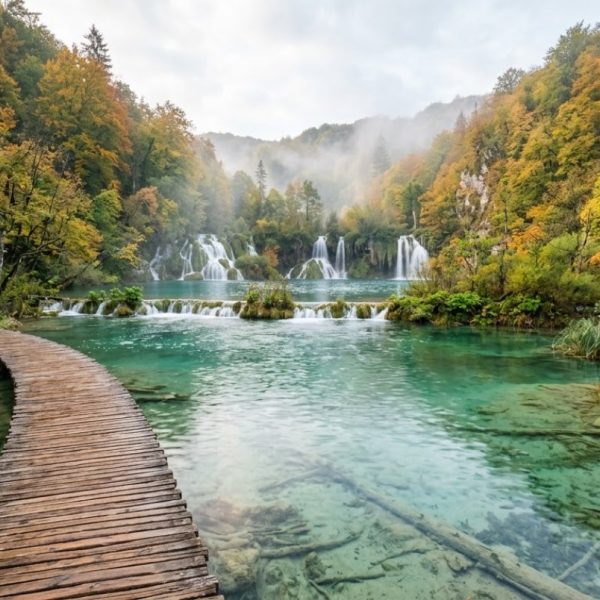
There are two versions of Plitvice Lakes. One is the version on the postcards: turquoise water spilling over mossy ledges, empty boardwalks, light coming sideways through beech trees. The other is the version most people actually get, which is a slow shuffle behind four hundred strangers on a wooden walkway a metre wide, in August, at eleven in the morning.
The difference between those two experiences is almost entirely a matter of timing and planning, and it is easier to engineer than most visitors realise.
What You Are Actually Looking At
Croatia's oldest national park protects sixteen terraced lakes that step down a wooded valley, connected by a continuous run of waterfalls. What makes it geologically unusual is that the barriers holding the lakes back are alive. Moss and algae in the water trap dissolved calcium carbonate, which hardens into travertine, and the barriers grow by roughly a centimetre a year. The landscape is quite literally still being built.
That is also why you cannot swim, cannot leave the boardwalks, and cannot bring a dog off the lead. The barriers are fragile and a footstep in the wrong place undoes decades. UNESCO inscribed the park on the World Heritage list in 1979, and the visitor restrictions are a direct consequence of how easily the formations are damaged.
How the Ticket System Works
Plitvice Lakes National Park tickets are sold for a specific entry time, not for a day. You choose a slot when you book, and you are expected to enter within it. In high summer the popular morning slots sell out days ahead, so booking online in advance is not optional if you have a fixed itinerary.
The counterintuitive move is to avoid the first slots entirely. Everyone books the earliest available time on the theory that they will beat the crowd, which means the early slots are the crowd. A mid-afternoon entry in summer, when the tour buses have started to leave, gives you softer light and a noticeably emptier trail.
Your ticket includes the electric boat across Lake Kozjak and the panoramic shuttle buses. Both are part of the route rather than optional extras, and both develop queues of their own around midday.
Entrance 1 or Entrance 2
This is the decision people get wrong. Entrance 1 sits at the bottom of the system, near the Lower Lakes and the tall waterfall most photographs feature. Entrance 2 sits higher, at the Upper Lakes, where the terraces are broader and greener and the crowds thin faster.
Starting at Entrance 1 means walking uphill through the busiest section first. Starting at Entrance 2 means the boat comes early in your day and the dramatic lower falls arrive as a finale, when the light is usually better anyway. Unless you are on a tight schedule, Entrance 2 is the more comfortable route.
The park signs its walks with letters rather than names. The short circuits take two or three hours, the full loops take six or more, and the letters mean nothing until you look at a map, so photograph the board at the entrance before you set off.
Getting There
The park sits inland, roughly halfway between the capital and the coast. The Zagreb to Plitvice Lakes run is the easy one: about two hours by car, a little more by bus, on a good road most of the way. Buses drop at the entrances rather than in a town, which matters if you were expecting a bus station.
Timing a visit to Plitvice well is mostly about avoiding the hour when everyone else has the same idea. Reading works on a similar rhythm, which is why the titles chosen by celebrity book clubs are often best enjoyed a season after the announcement rather than during the rush. The queue passes and the book does not change.
Planning a visit around the crowds is really an exercise in deciding what you want the day to be for. That question of what makes an experience worth having is the sort of thing an introduction to philosophy for beginners handles better than any travel guide. Timing solves the queue; intent solves the trip.
Timing is the single biggest variable in any popular destination. Arriving an hour before the coaches, or a fortnight either side of peak season, changes the experience more than any amount of planning. The same logic applies to thailand travel, where the difference between March and July is not marginal.
Split to Plitvice Lakes is a longer proposition, closer to four hours each way by public transport, which makes a day trip technically possible and genuinely miserable. Zadar is the far better coastal base, at around two hours. If you are driving, arrive before your slot rather than exactly on it, because the car parks fill and the walk from the overflow is not short.
When to Go
May and June are the strongest months. Snowmelt keeps the falls loud, the beech canopy is fully out, and the days are long. October is the connoisseur's choice, with the whole valley turning copper and visitor numbers falling off a cliff after the first week.
July and August are hot, busy and expensive, and the water level drops noticeably by late summer, so the waterfalls are at their least impressive exactly when the crowds peak. Winter is beautiful and half the trails close, which is a fair trade if you know it in advance.
A Note on Language
Croatian is not a difficult language for visitors, largely because it is written phonetically and almost everyone working in tourism speaks excellent English. Away from the park, in the villages of the Lika region or across the border in Bosnia, that thins out quickly.
Anyone stretching a trip like this into a longer stay soon meets paperwork that has to hold up in two languages at once. Rental agreements, insurance forms, and anything an authority must accept officially rarely survive a hurried word-for-word rendering. That is where certified translation services earn their keep, pairing the translation with a signed statement of accuracy that institutions can rely on. Arranging it before you leave home is far easier than trying to repair a rejected document from a hotel room.
A handful of travel phrases goes further here than in most of Europe, partly because so few visitors bother. It also helps to understand that the languages of the region sit on a continuum rather than in neat boxes, something this survey of Serbian dialects and how they emerged lays out clearly. Ask for the right thing in roughly the right accent and doors open, which is a useful piece of equipment to carry into a valley full of tour groups.